
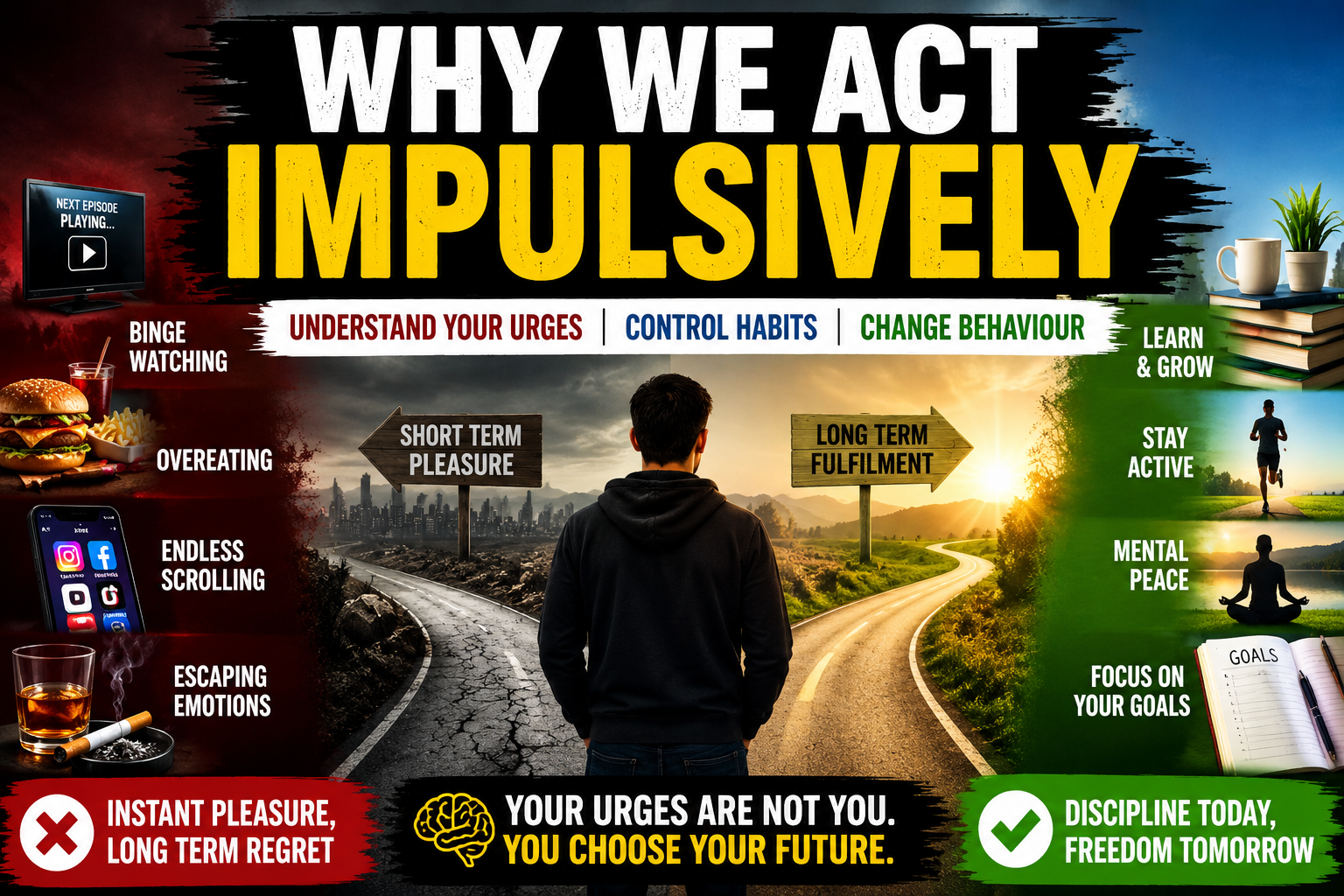
Understanding Impulsive Behaviour: Why We Do Things We Later Regret
Acting on impulses often feels good at first, but it can bring problems later. Understanding these urges can help us control them.
Have you ever decided to watch just one episode but ended up watching three or four in a row? Or planned not to eat too much while going out, but ended up overeating? Have you ever said something in anger that you later regretted? Or spent hours scrolling on social media without realizing it?
If you have experienced any of these behaviours, congratulations — you are human.
We all go through moments when we act impulsively.
Why Does Impulsive Behaviour Happen?
Impulsive behaviour is often driven by the desire for instant pleasure or excitement. But sometimes, it is also an attempt to escape unpleasant emotions.
For example, someone going through a painful breakup may choose alcohol to avoid sadness. Drinking once or twice may not seem harmful, but when it becomes a daily habit, it can begin to affect personal and professional life.
Before finding a solution, it is important to understand conditioning.
For example, when a person feels anxious, they smoke. Over time, the mind becomes conditioned in such a way that whenever anxiety appears, the person feels the need for a cigarette. Afterward, a cycle of guilt often begins.
Identify Why You Want to Become Less Impulsive
Take a moment and identify an impulsive behaviour that is interfering with your life. It may seem difficult to stop, but believe me — you can change it.
Now ask yourself:
What do I truly want from my life?
How would my life improve if this behaviour disappeared?
Write your answers somewhere — on your phone or in a journal — where you can read them regularly.
Next, write down the negative consequences of continuing the behaviour. Keep both lists in a place where you can see them often.
Pause Before Reacting
Instead of automatically acting on an impulse, pause for a moment.
Try to tolerate the emotion or urge long enough to think about the long-term consequences.
You can also try deep breathing or relaxation techniques. For example, you can practice self-hypnosis or relaxation here:
Self-Hypnosis Relaxation Guide
Use Urge Roadblocks and Healthy Distractions
Whenever you act on an urge, your brain strengthens that behaviour pattern. But the opposite is also true.
Urges rise and fall like waves. If you can “ride out” the urge without acting on it, it will eventually become weaker.
It may feel difficult at first, but the intensity of the urge will pass.
Create a plan for what you will do when a certain urge appears.
For example:
- If you tend to overeat, avoid keeping tempting food at home.
- If social media distracts you, set time limits or keep your phone away.
- Replace harmful instant pleasure with healthier alternatives, such as physical activity, a walk, or calling a friend.
Our mind often seeks instant pleasure, but we can train it to choose healthier rewards.
Final Thought
Changing conditioned behaviour takes time, and progress is rarely linear. What matters most is that you keep moving toward a life that feels more aligned with your goals and values.