
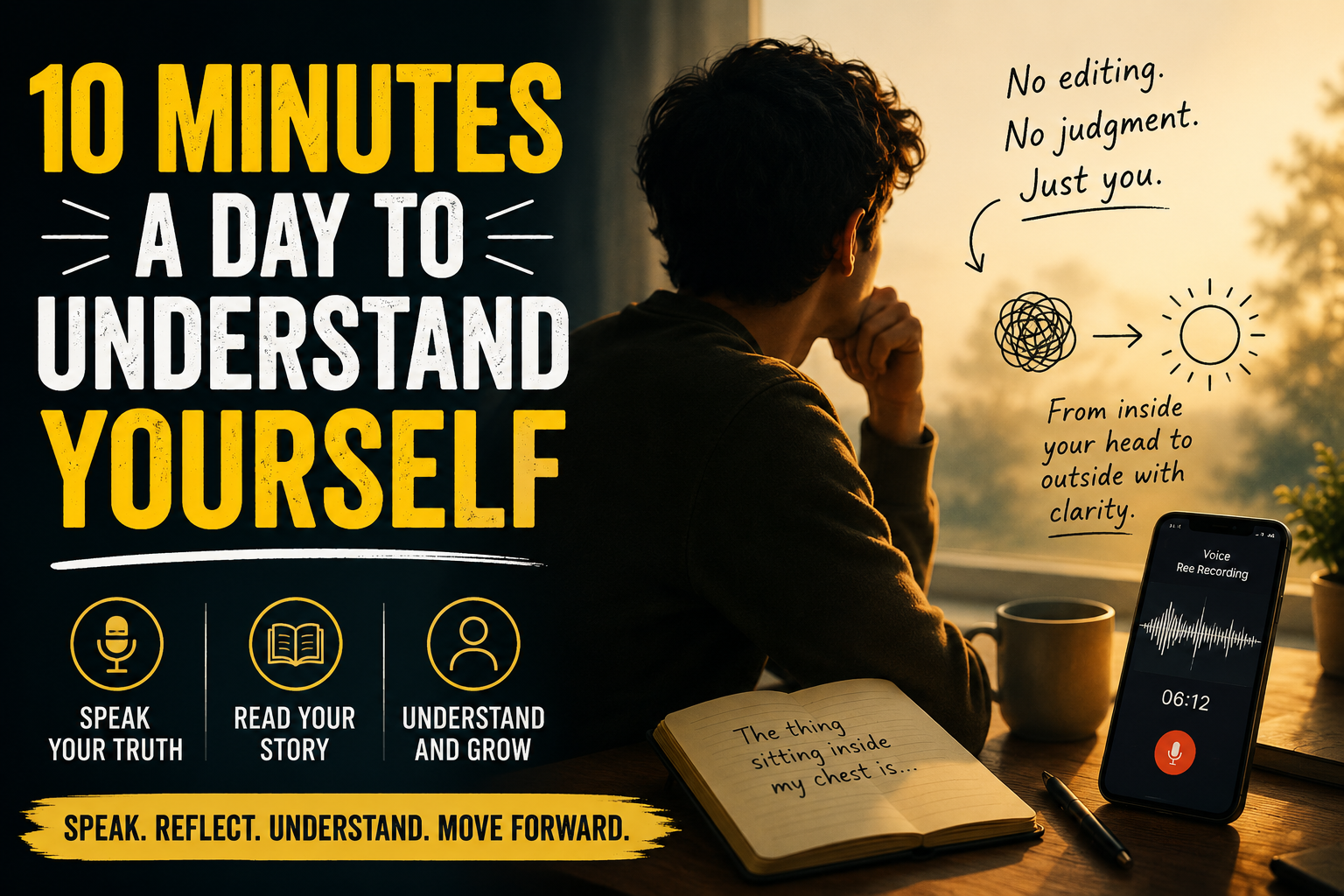
I bet there are days when your mind feels like an overflowing inbox. Thoughts pile up, unanswered. Emotions sit quietly in the background, waiting for attention.
And sometimes, what you need is not more thoughts about your thoughts — you just need a place to let them exist.
Almost by accident, I discovered something unusual.
One day, I opened the voice-to-text feature on my phone — not to dictate tasks or notes, but to narrate my inner life in real time.
For a few minutes, I simply spoke.
How I felt.
What I hoped for.
What I felt guilty about.
I did not edit. I did not organize my thoughts. I just let everything pour out.
Later, I started reading the transcripts.
At first, it felt uncomfortable — almost strange. But over time, something shifted. Instead of judging myself, I became curious.
Who is this person today?
What does he truly want?
What is stopping him from moving forward?
That small shift — from being trapped inside your thoughts to becoming an observer of them — creates a new kind of space.
The advantage of voice recording is simple: you cannot edit yourself as easily as you can while journaling. What is inside you comes outside more honestly.
You are not trying to impress anyone. You are not creating something to publish.
You only need ten minutes a day and the willingness to tell yourself the truth, even if only for a moment.
Then, a small commitment: come back and read your story with care.
Find a quiet place. Give yourself ten minutes.
Though, honestly, I bet most turbulence inside you will run out in six.
Regularity matters more than length. If you miss a day, do not punish yourself. Simply return tomorrow.
In those few minutes, say everything.
“The thing sitting inside my chest is…”
Start there.
If your thoughts jump from one topic to another, that is fine.
If you contradict yourself, that is also fine.
No one becomes a monk in a day. Even monks have walked through confusion before finding stillness.
But eventually, this practice becomes something deeper — almost philosophical.
Read yourself not as a person, but as a character.
Imagine you are a friend trying to understand this human being with patience and compassion.
The shift from “I” to “they” is subtle, but powerful.
Distance helps clarity.
Sometimes, to understand yourself truly, you need a little space between you and your experience.
Then ask yourself:
“If this character wanted to move in a helpful direction tomorrow, what would that look like?”
Not a perfect plan.
Not a complete transformation.
Just an idea.
Ending
Because maybe self-understanding does not arrive through dramatic breakthroughs.
Maybe it begins quietly — with ten honest minutes, an unfiltered voice, and the courage to listen to yourself without judgment.
You may discover that beneath all the noise, there was never a broken person inside you.
Only someone trying, in the best way they knew how, to be understood — even by themselves.
And perhaps that is where real change begins.