
Why Do We Fear the Past?
Fear protects us from future harm. It evolved to help us prepare for danger, avoid threats, and increase our chances of survival. But if fear is meant to protect us from what might happen, why do we sometimes find ourselves afraid of things that have already happened?
At first glance, this seems strange. Fear is usually understood as a forward-looking emotion. Aristotle described fear as “a mental picture of a painful evil in the future.” From an evolutionary perspective, fear prepares us for dangers that lie ahead.
Fear keeps its eyes on tomorrow—even when it is thinking about yesterday.
How is that possible?
Consider a simple example. You turn a corner and see a dog. What are you afraid of? Not the dog itself. The dog is in the present. What you fear is what the dog might do—perhaps it might bite you.
The dog is the object of fear, but the bite is the anticipated harm.
This distinction is important. Every fear has two components:
The topic of fear — what your mind identifies as dangerous.
The target of fear — the harm your mind is bracing for.
In the dog example, the dog is the topic, while the bite is the target.
Fear is not simply about recognizing danger; it is about anticipating consequences. To qualify as fear in the full sense, the emotion must make a forward-looking leap. It must connect a perceived danger to a possible future harm.
This forward-looking structure helps explain why we can sometimes fear events that are already in the past.
There are at least three ways this can happen.
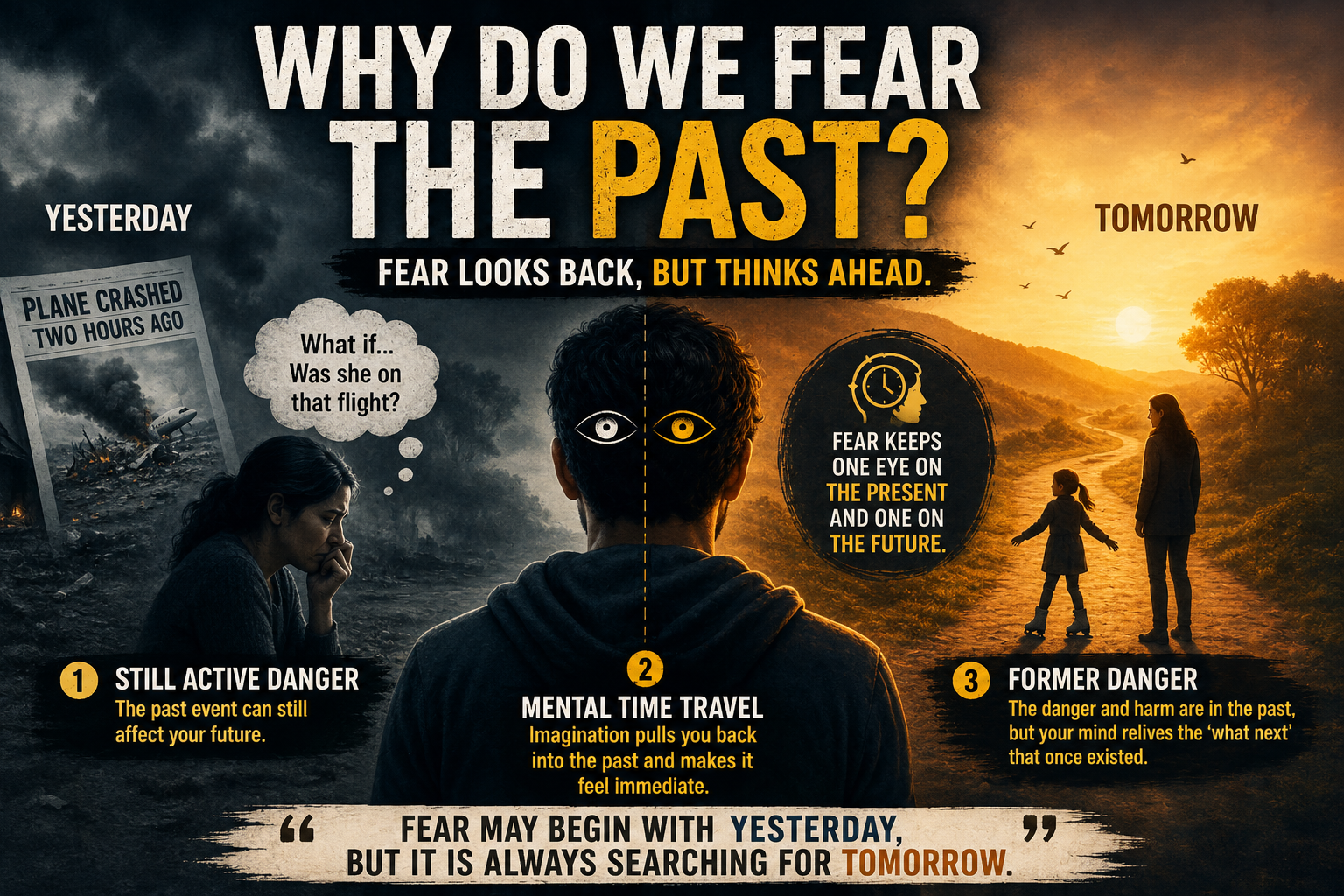
1. Still-Active Dangers: When the Threat Can Still Harm You
Imagine you read a news report that a plane crashed two hours ago. Your mother is travelling today, but you do not know which flight she took.
The crash is already in the past. There is nothing you can do to prevent it. Yet fear immediately takes hold.
Why?
Because your mind is not merely processing a historical fact. It is asking what the consequences could mean for your future.
You begin to wonder:
- Was she on that flight?
- What if something happened to her?
- How would I manage without her?
- What would happen to our family?
The danger lies in the past, but the potential harm still extends into the future. Fear remains active because the outcome has not yet been resolved from your perspective.
2. Mental Time Travel: When Imagination Makes the Past Feel Present
Sometimes fear of the past feels immediate and overwhelming. Your heart races, your stomach tightens, and your mind becomes consumed by an event that has already happened.
Part of the explanation lies in our ability to mentally travel through time.
Human imagination does more than consider possibilities—it allows us to relive experiences and vividly simulate events.
Returning to the plane-crash example, imagine you become absorbed in the story. You picture the aircraft, the panic inside the cabin, the moment of impact, and life afterward if your mother were gone.
You are no longer merely thinking about the event. You are experiencing it in your imagination.
The mind can become so immersed in these imagined scenes that the emotional response resembles fear of a present threat. Even though the event is fixed, imagination recreates the uncertainty and emotional weight associated with it.
In this sense, fear is fueled not by the past itself, but by the vivid mental world we construct around it.
3. Former Dangers: When Both the Danger and Harm Are in the Past
The most puzzling cases occur when both the danger and its consequences are already settled.
Imagine it is afternoon, and your daughter went ice skating earlier without supervision.
At this point, one of two things has already happened:
- She fell and injured herself.
- She did not.
The outcome is already fixed.
Yet you still feel fear.
What is going on?
Even here, fear retains its forward-looking character. Your mind is not looking toward the future from the present moment; instead, it is looking toward the future from the standpoint of the earlier event.
You mentally place yourself back in the situation and imagine the uncertainty that existed at that time. You relive the question: What will happen next?
In these cases, fear echoes a future that once existed within the event itself.
The danger and harm may now belong to the past, but your imagination reconstructs the perspective of someone who did not yet know the outcome.