
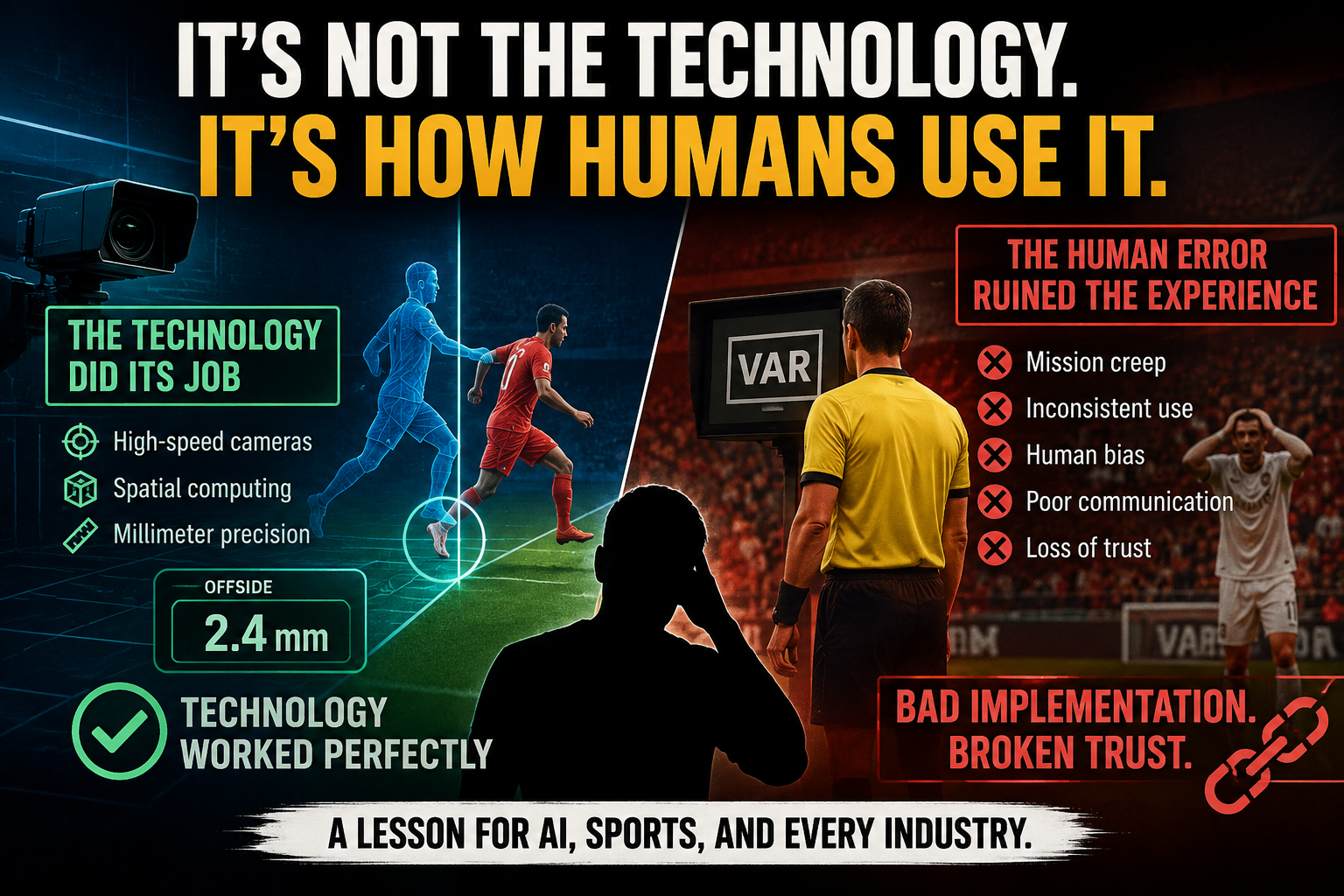
If you observe how people react to new technologies, you will realize that success or failure is rarely about silicon, software, or network infrastructure. More often, it is about the people using the technology. We recently witnessed this phenomenon on a global stage with the FIFA Video Assistant Referee (VAR) system.
What was expected to be a triumph of high-speed cameras, spatial computing, and precise engineering instead became a huge disappointment for many fans. However, from an analytical perspective, the software and hardware did not fail. The system performed exactly as it was designed to: detecting offsides with mathematical precision using advanced algorithms. The real failure lay in human implementation, mission creep, and the catastrophic mismanagement of public perception.
This is the same pattern we often see with enterprise AI deployments. When a multimillion-dollar AI project fails, people are quick to blame the model or algorithm. In reality, nine out of ten times, the technology works as intended—the failure lies in how the system is implemented, governed, and communicated.
VAR was originally introduced to correct only clear and obvious errors, such as missed offsides or handball goals. However, during the 2026 tournament, its purpose expanded beyond this original objective, a phenomenon known as mission creep. Referees began overturning goals because of millimeter-level offsides that occurred much earlier in the build-up play. Although the technology was accurate, its excessive use disrupted the flow, excitement, and emotional appeal of football. The issue was not with the technology itself but with how humans chose to apply it.
Another major concern was the perception of bias. Many fans argued that VAR favored wealthier or more influential nations. In reality, the system does not recognize the color of a team’s jersey or the country’s reputation. The algorithm itself is unbiased. However, selective bias can emerge when referees decide when to consult VAR and when not to. This inconsistency introduces human bias into an otherwise objective system. A similar situation exists in many industries today. AI models are generally not biased by design, but the people deploying and using them can unintentionally introduce bias through their decisions.
A well-known example is Microsoft’s AI chatbot, Tay. Microsoft built a highly responsive, fast-learning conversational AI that behaved exactly as it was designed to. Tay learned conversational patterns from users on Twitter. The failure was not in Microsoft’s underlying model but in the behavior of internet users, who deliberately trained the chatbot with toxic and racist content. As a result, Microsoft had to shut Tay down in less than 24 hours.
Public perception quickly concluded that Microsoft had built a racist AI. In reality, Microsoft had built a system that accurately reflected the data it received. The technology acted like a mirror, and people did not like what that mirror revealed about human behavior.
The FIFA World Cup 2026 VAR controversy is therefore not a story about broken cameras or faulty offside software. It is a story about what happens when an extremely precise technology is introduced into an emotional, fast-moving environment without a clear and limited mandate. When humans misuse a powerful tool and the public perceives it as biased, unfair, or oppressive, trust in that technology disappears—regardless of how brilliantly the engineers designed it.
The biggest lesson for organizations deploying AI is that technical excellence alone is not enough. Successful AI adoption requires clear governance, thoughtful implementation, consistent decision-making, and effective communication with users. Without these, even the most accurate technology can fail in the eyes of the public.