
India’s EV Revolution: Collaboration, Hybrid or Ban?
India’s electric-vehicle (EV) revolution is, in many ways, closely linked to China. A significant share of the components that form the “brain” of an EV—including battery-management systems (BMS), power electronics and other critical electronic components—are imported from China. As the push toward cleaner mobility and alternatives to conventional fuels grows louder, EVs are emerging as an increasingly popular alternative in India.
Many Indian automakers manage the customer-facing side of the business, including branding, sales and distribution, while depending heavily on global suppliers for critical EV technologies and components. Battery supply chains are one of the most important areas of this dependence, with China playing a major role in global battery manufacturing and raw-material processing.
But this dependence raises a question that goes beyond economics: cybersecurity.
Modern EV batteries are not simply energy-storage devices. They are managed by sophisticated electronic systems that monitor battery health, temperature, charging, power delivery and other parameters. When these systems are connected to a vehicle’s broader digital architecture, vulnerabilities could potentially create risks related to data privacy, remote access and vehicle control. Therefore, dependence on foreign technology in critical EV systems needs to be evaluated not only from a supply-chain perspective but also from a cybersecurity and national-security perspective.
The risks do not end with batteries and electronic systems. China also occupies a dominant position in the global supply chain for several critical minerals and rare-earth elements used in advanced technologies. Any disruption in the supply of these materials—or delays in the clearance and delivery of critical EV components—could expose the vulnerabilities of countries that rely heavily on a single source.
What has raised concerns further is China’s National Intelligence Law of 2017, which contains provisions requiring relevant organizations and citizens to support and cooperate with national intelligence work. This has contributed to concerns in other countries about how data handled by Chinese companies could potentially be accessed by Chinese authorities.
These concerns are not limited to India. The United States has also taken a much more cautious approach toward connected-vehicle technology originating from China. Washington has introduced measures aimed at addressing national-security and cybersecurity risks associated with connected vehicles and Chinese-linked technology.
India has already demonstrated that it is willing to restrict Chinese technology in strategically sensitive areas. The ban on TikTok and several other Chinese applications showed that national security and data concerns can influence technology policy. However, India’s approach toward Chinese EV technology remains more nuanced and continues to evolve.
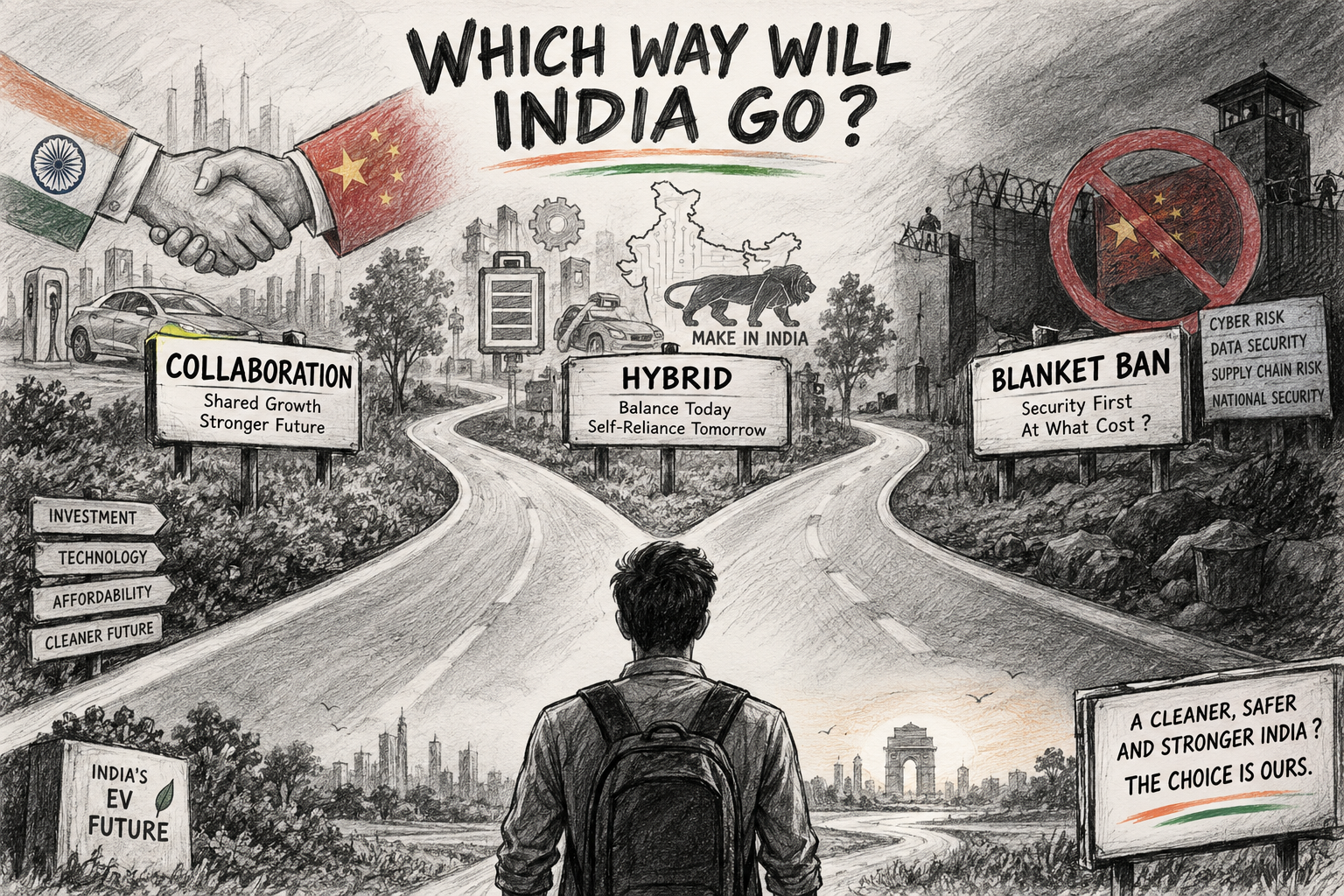
The real question, therefore, is not simply whether India should “allow” or “ban” Chinese EV technology.
Where should India draw the line?
Should India choose collaboration, allowing Chinese technology and capital to participate while strengthening regulatory oversight?
Should it pursue a hybrid approach, combining Chinese components with domestic manufacturing and gradually building indigenous capabilities?
Or should India eventually consider a blanket ban on Chinese EV technologies in strategically sensitive areas?
For India, the challenge is to strike a balance between affordability, technological advancement, supply-chain resilience, cybersecurity and national security.
The direction India chooses could shape not only the future of its EV industry, but also its broader strategy for technological and economic sovereignty.