
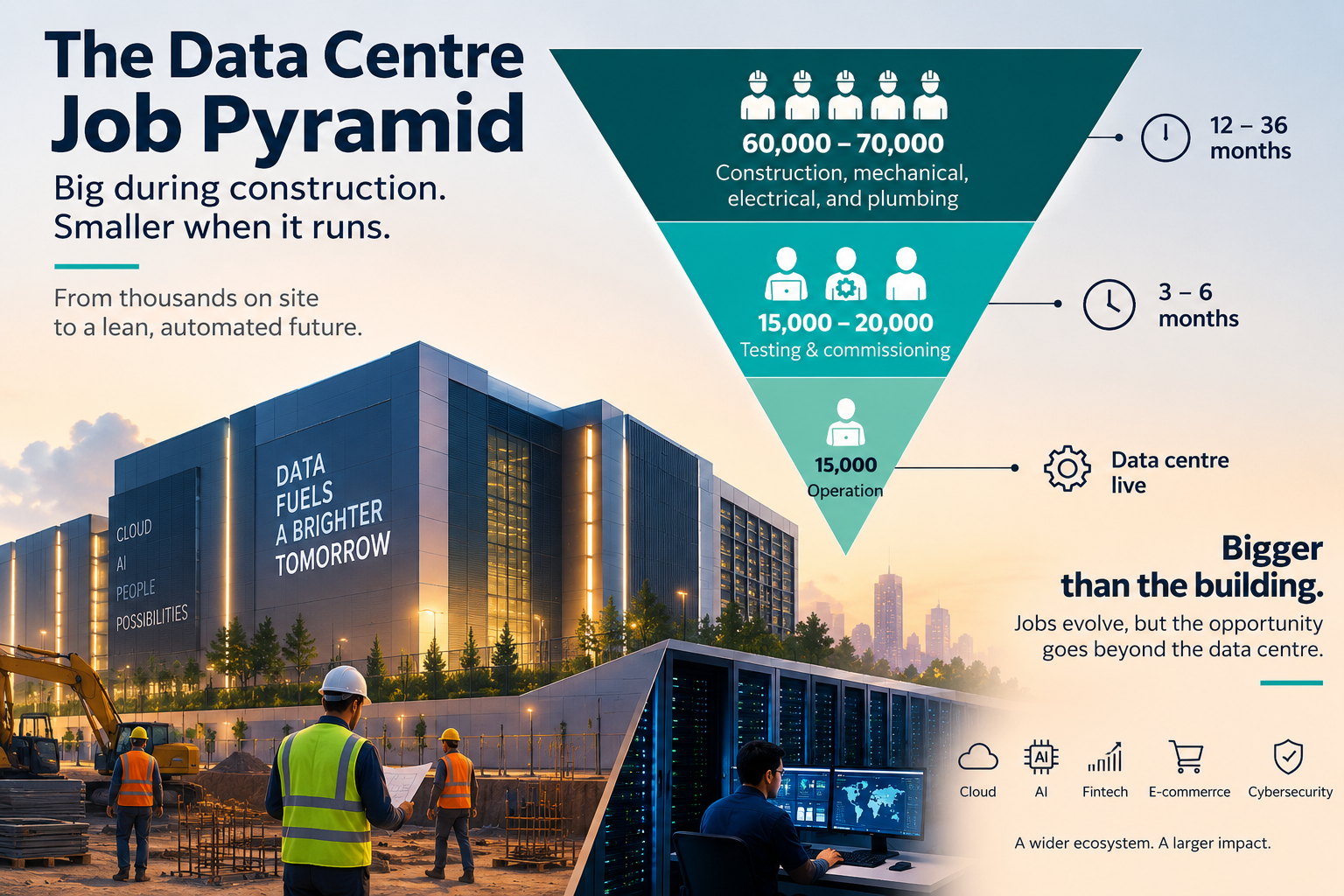
Modern data centres are, by design, resentful of human presence: the fewer the badges, the fewer the breaches. In other words, if fewer ID cards have access to a data centre, the lower the chances of security breaches. These are the facilities that every state is eager to build, even while facing revenue deficits. The reason is simple: no one wants to be left behind in the AI revolution. States want to become major hubs for data storage and computing and achieve greater data sovereignty. Like any new industry, the data-centre industry also promises abundant employment, but that promise may turn out to be a case of “loaded promises for empty buildings.”
Constructing a data centre requires a large workforce, but once construction is completed, operations become highly automated and require relatively little human intervention. However, if we look at the broader ecosystem, data centres can create many indirect jobs in areas such as cloud computing, AI, fintech, e-commerce, cybersecurity, and IT services. Therefore, we should not look at data centres in isolation; we should consider the wider digital ecosystem that can develop around them.
From an employment perspective, data centres do not necessarily need to be built in India to create many of these broader jobs. India’s labour economics has always been attractive, particularly for skilled IT services. A company could potentially employ several skilled workers in India for the cost of one comparable employee in the US. For example, a data-centre monitoring business could set up its operations in India and remotely monitor servers located halfway around the world. This means that many jobs associated with operating and supporting data centres can be created in India even when the physical data centre is located elsewhere.
We should also learn from Guizhou, China, which took a different approach. Instead of focusing only on building data centres or creating direct jobs, Guizhou built the infrastructure first and used it to attract an entire digital ecosystem. The goal was to create a base that companies beyond data-centre operators could plug into. In contrast, Indian states appear to be focusing more on individual investments and separate deals with companies.
The bigger question is: who actually captures the value created by these data centres? In reality, India is providing many of the physical resources required to build them—land, electricity, water, and tax incentives—while large foreign technology companies provide the servers, control much of the software and technology, and maintain direct relationships with customers.
India plans to build around 10 GW of data-centre capacity by 2030. However, if we follow the current strategy, much of this capacity could be used by foreign companies rather than Indian businesses. This raises an important question: Are we building data centres merely to attract investment, or are we building them to create a broader digital ecosystem that generates long-term value for India?
The success of India’s data-centre strategy should therefore not be measured only by the number of data centres built or the amount of investment announced. We should also ask how many sustainable jobs are created, how much value is captured by Indian companies, how much local digital infrastructure develops around these facilities, and whether these investments ultimately strengthen India’s position in the global AI and digital economy.