
I remember the first time someone told me that I could not be whoever I wanted to be. I was in high school—a notorious student who loved making jokes—and I said that I wanted to become a professional writer. My teacher looked at me and said, “Oh no!”
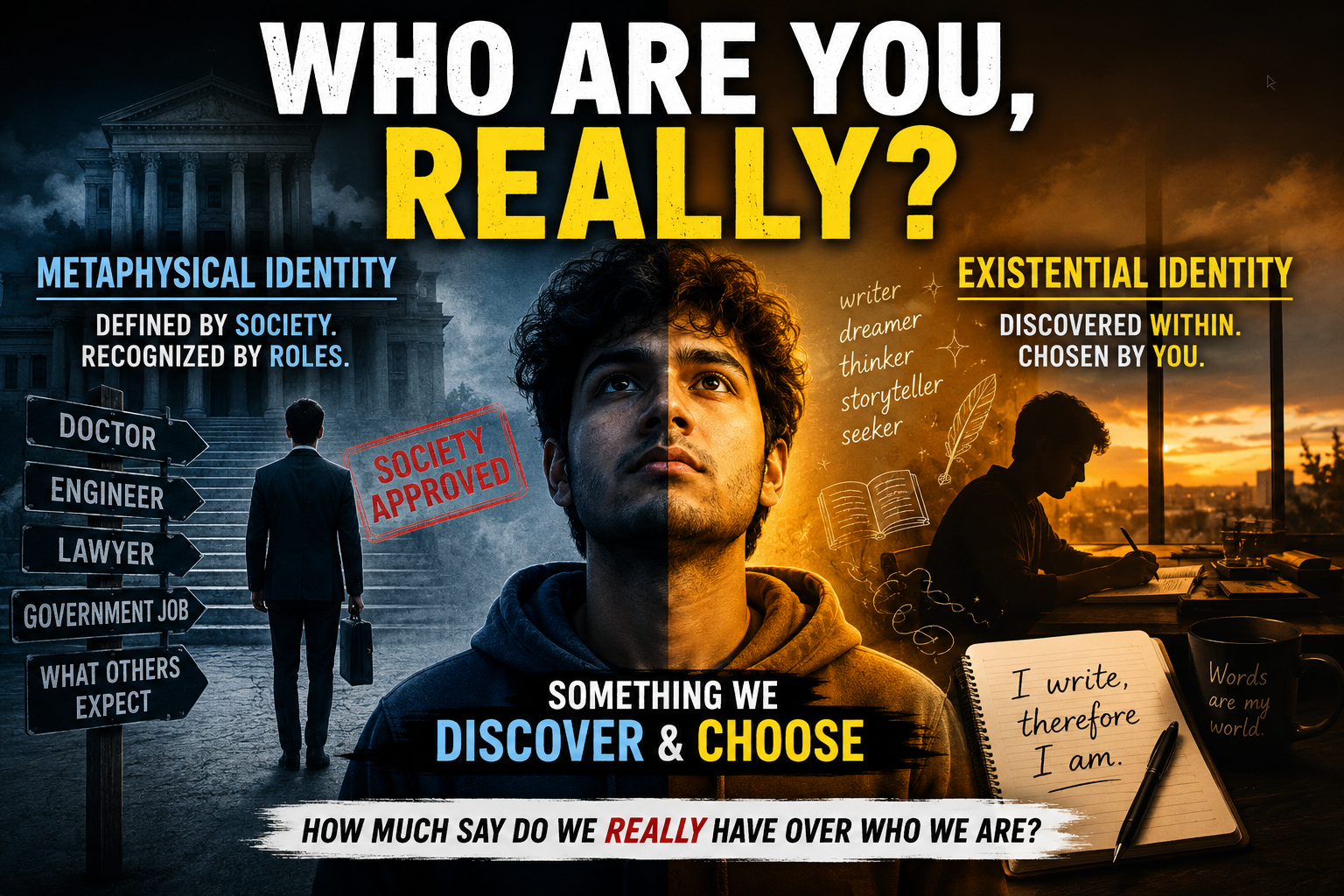
I had never taken my studies seriously. I played sports for fun and rarely thought about my future. But it came as a shock when someone told me that there was a limit to who I could become. Society could open doors for me if it found me worthy, but at the same time, it could slam those doors in my face. This made me wonder: How much say do we really have over who we are?
Broadly speaking, there are two philosophical camps. On the one hand, there are the existentialists, who argue that we are the authors of our own identity. As Jean-Paul Sartre famously wrote:
“Man first exists, encounters himself, surges up in the world—and defines himself afterward.”
On the other hand, there are those who argue that who we are is not determined by individual choice alone. Instead, our identity is shaped by social forces and the roles society recognizes.
I think both sides are right because they are referring to two different kinds of identity: metaphysical identity and existential identity.
Metaphysical identity is straightforward. It refers to what you are in the eyes of society—whether you are a firefighter, a doctor, or a school teacher. Existential identity, however, is much deeper. It concerns your values, passions, and what truly matters to you. Maybe deep down you are a poet, a lover, an artist, or perhaps your true self is still a mystery. That does not mean you have no identity; it simply means you have to look deeper to discover it.
So, if we really want to know who we are, we have to answer two questions:
First, what makes you who you are metaphysically?
Second, who are you existentially?
Let’s start with metaphysical identity. In many ways, you do not decide it—society does. Wanting to be a doctor or feeling like a doctor does not make you one. You must satisfy society’s requirements: pass the medical entrance exam, complete years of rigorous study, and prove your competence by treating patients. Only then does society place its stamp on you and say, “You are a doctor.”
Existential identity is different. It feels both like something we discover and something we choose because it is something we avow—something we consciously embrace as part of who we are. Whenever I discover something about myself, I am not merely a passive observer; I am an active participant in the process.
For example, I chose to pursue a B.Tech because my family and friends wanted me to. But during engineering, I discovered that I was good at writing. I then chose to develop that talent and embrace it. Becoming a writer is not merely my profession—it is part of my existential identity.
Sometimes our metaphysical identity and existential identity align. A person may genuinely love being a doctor, teacher, or firefighter. But more often than not, they do not. Society may recognize us as one thing, while deep inside we know ourselves to be something entirely different.