
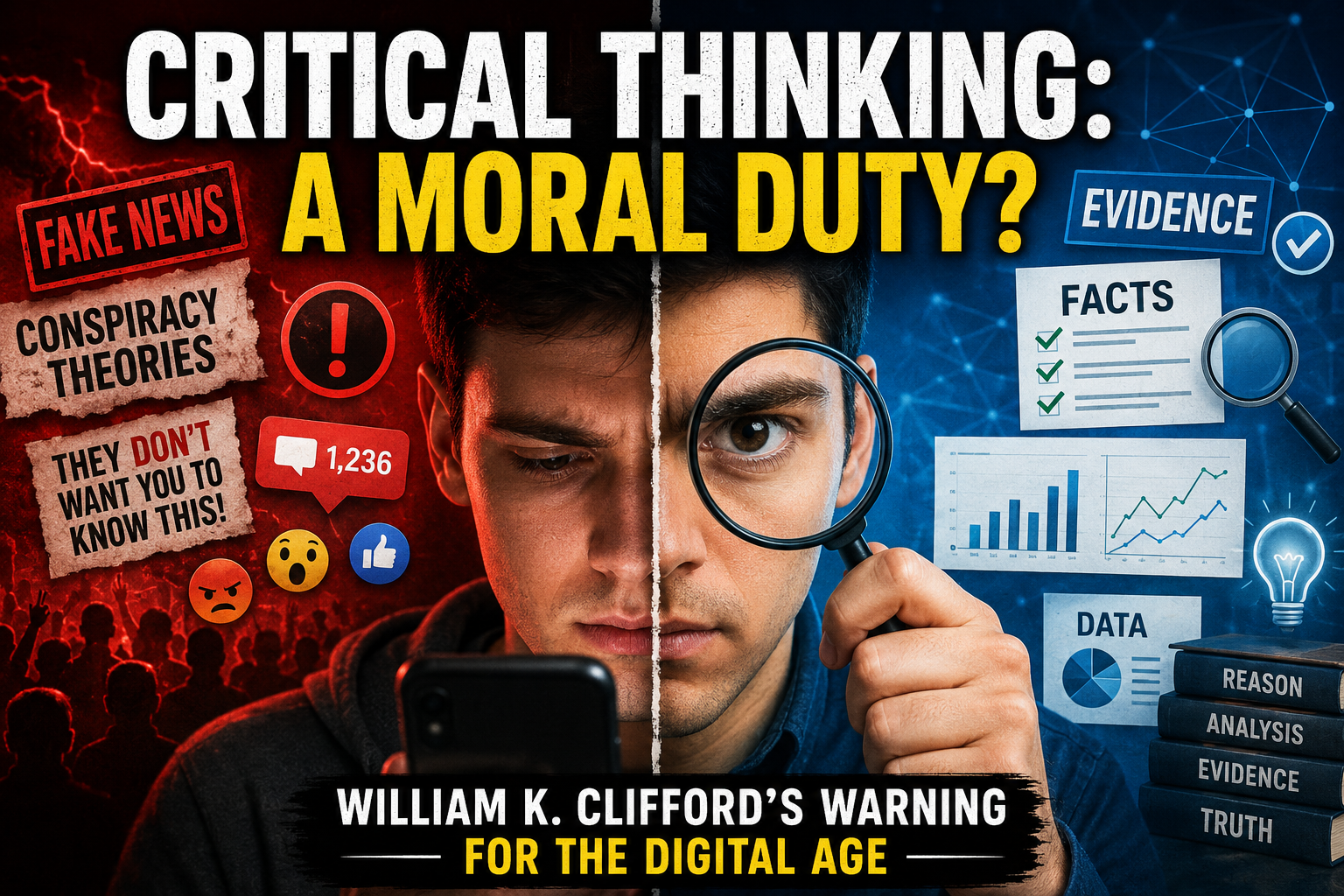
Why Critical Thinking Is a Moral Responsibility in the Digital Age
You have probably never heard of William Kingdon Clifford. He is not usually listed among the greatest philosophers, and his life was tragically cut short at the age of 33. Yet I can think of few thinkers whose ideas are more relevant to our digital world.
Clifford argued that we have a moral obligation to form our beliefs responsibly — that is, to believe only what is supported by sufficient evidence. His famous principle was simple:
“It is wrong, always, everywhere, and for anyone, to believe anything upon insufficient evidence.”
He offered three powerful reasons for this view.
1. Our Beliefs Shape Our Actions
The first reason is straightforward: our beliefs influence how we behave.
If I believe that stealing is wrong, I will pay for my purchases. If I believe that taxis do not accept credit cards, I will bring cash with me. Whether true or false, beliefs guide our decisions every day.
Because beliefs influence actions, forming them carelessly can lead to poor decisions and harmful consequences.
2. Careless Beliefs Create Careless Thinkers
Clifford’s second argument is that poor habits of belief formation gradually turn us into careless and credulous people.
As he wrote:
“No real belief, however trifling and fragmentary it may seem, is ever truly insignificant; it prepares us to receive more of its like, confirms those which resembled it before, and weakens others.”
Every belief we accept without evidence makes it easier to accept the next unsupported claim. Over time, this habit shapes our character.
In today’s world, this is especially dangerous. Misinformation spreads faster than ever through social media, messaging apps, and online communities. When we stop questioning information and start accepting claims simply because they confirm our existing views, we become easy prey for false news, conspiracy theories, and manipulation.
Critical thinking is not merely an intellectual skill; it is a safeguard against deception.
3. We Share Responsibility for Collective Knowledge
Clifford’s third and most profound argument is that our beliefs do not belong only to us.
As communicators of ideas, we contribute to a shared pool of knowledge. In Clifford’s time, this happened mainly through conversation, books, newspapers, and letters. He argued that our words, phrases, and ways of thinking become part of society’s common intellectual inheritance.
When we spread false beliefs, we contaminate this shared resource. This is morally wrong because everyone depends upon reliable knowledge to make decisions and live their lives.
The Big Data Age
Today, Clifford’s argument is even more relevant.
We now participate in a vast global reservoir of information known as Big Data. Every search, click, purchase, like, share, and comment contributes to a digital record that algorithms use to understand and predict human behavior.
You do not even need to be actively posting online. More and more of what we do in the real world is recorded, digitized, and analyzed. In many cases, algorithms can infer our beliefs before we explicitly express them.
When inaccurate information enters this system, the consequences can spread far beyond a single individual. Bad data can produce biased recommendations, distorted narratives, and harmful decisions at scale.
Add the wrong ingredients to the Big Data recipe, and the result can be toxic.
Why It Matters Now
If there was ever a time when critical thinking was a moral imperative and credulity a dangerous vice, it is now.
In an age of information abundance, our responsibility is not simply to consume information but to evaluate it carefully. We must question sources, seek evidence, and remain willing to revise our beliefs when new facts emerge.
Thinking critically is no longer just a personal advantage.
It is a civic responsibility.
Every belief we hold, every claim we share, and every piece of information we pass on contributes to the world others must navigate.
The quality of our collective future depends on the quality of our thinking today.