
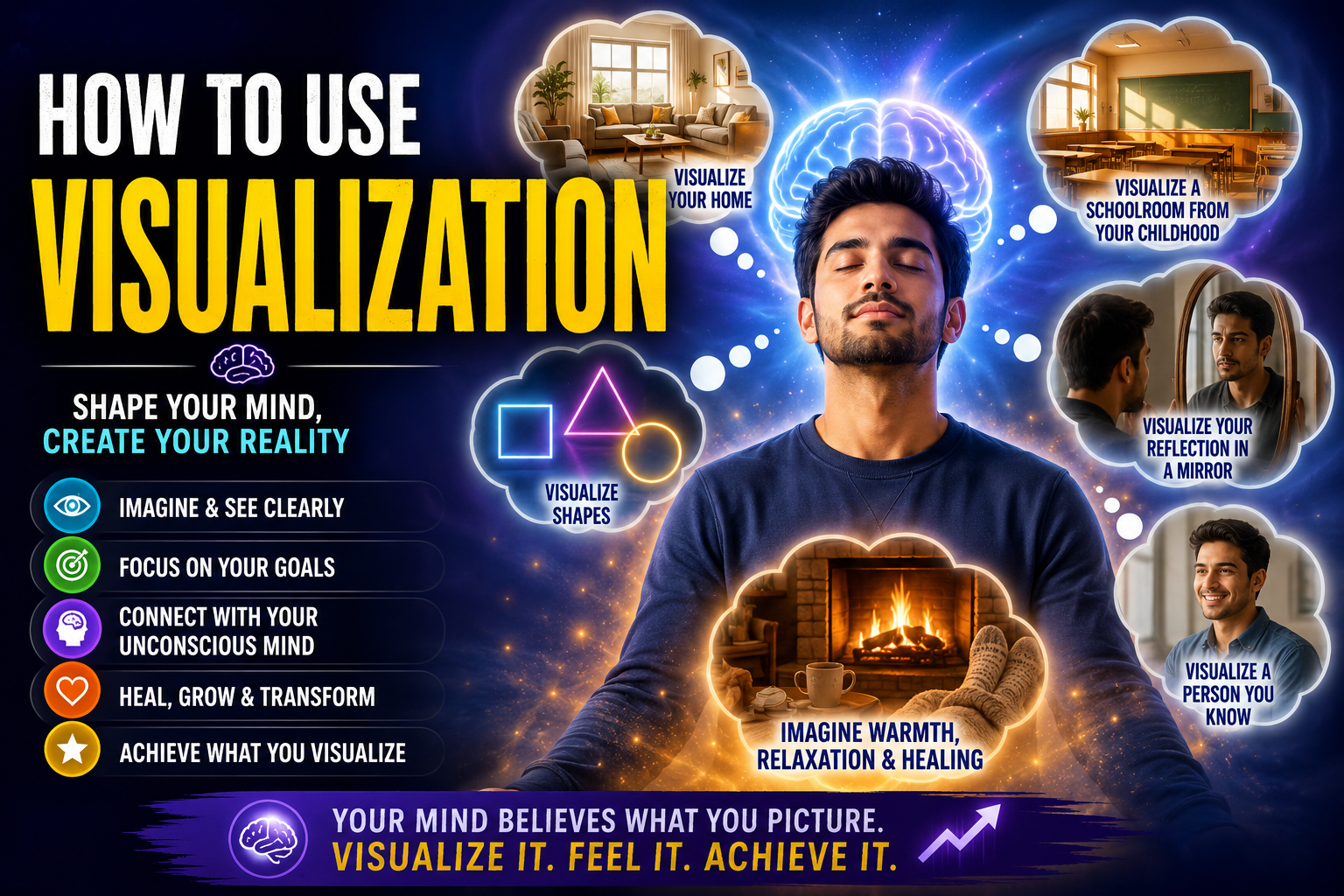
How to Use Visualization
Would you like to try a simple experiment?
Close your eyes and count the total number of windows in your room. The important question is not how many windows there are, but how you counted them. Most likely, you created a mental image of your room. A natural way of doing this is through imagery.
As Aristotle once said:
“The soul never thinks without a picture.”
Each of us tends to take in information from the world through our senses — sight, sound, and touch. Some people are more visual, others more auditory, and some rely more on feelings and sensations. What is your specialty?
Here are a few exercises that can help you strengthen your visualization skills:
1. Visualize Simple Shapes
Look at a geometric drawing such as a square, triangle, or circle. Study it for a few moments, then close your eyes and try to recreate it in your mind.
2. Visualize Your Home
Picture your home in detail. Imagine the rooms, furniture, colors, and layout.
3. Visualize a Classroom from Childhood
Try to remember a classroom from your school days. What did it look like? Where did you sit? Who was around you?
4. Visualize Yourself in a Mirror
Imagine your reflection in a mirror. Notice your facial expressions, posture, and details.
5. Visualize Someone You Know
Bring to mind a person you know well. Picture their face, expressions, voice, and mannerisms.
If you are suggesting to yourself that your arm is becoming cold and numb, try to remember a time when you actually felt cold and numb. Perhaps you were outside without gloves on a winter day. The goal is to create images based on real experiences because the mind responds strongly to familiar sensations.
Many clinicians believe that the better you are able to visualize your body and the area causing discomfort, the more effectively your unconscious mind may coordinate your body’s internal healing responses.
We generally use imagery in two principal ways to work toward a goal:
1. Process Imagery
This involves visualizing the actions needed to achieve success. You mentally rehearse the process step by step.
For example, if you are trying to reduce a vascular headache, you might imagine warmth flowing into your hands and feet. You may picture yourself sitting near a warm fireplace, feeling relaxed and comfortable. Many people find this type of imagery helpful for stress-related tension and headaches.
2. Result Imagery
This means imagining the outcome as if it has already happened.
For example, if your goal is to become healthier or slimmer, you may imagine yourself fitting comfortably into a particular dress or outfit, feeling confident and energetic.
Visualization is more than imagination — it is a way of communicating with your unconscious mind. By learning to speak to yourself through mental pictures, snapshots, and inner movies, you develop greater clarity, focus, and emotional connection with your goals.
The mind often moves in the direction of the pictures we repeatedly create. Choose your inner images carefully.