
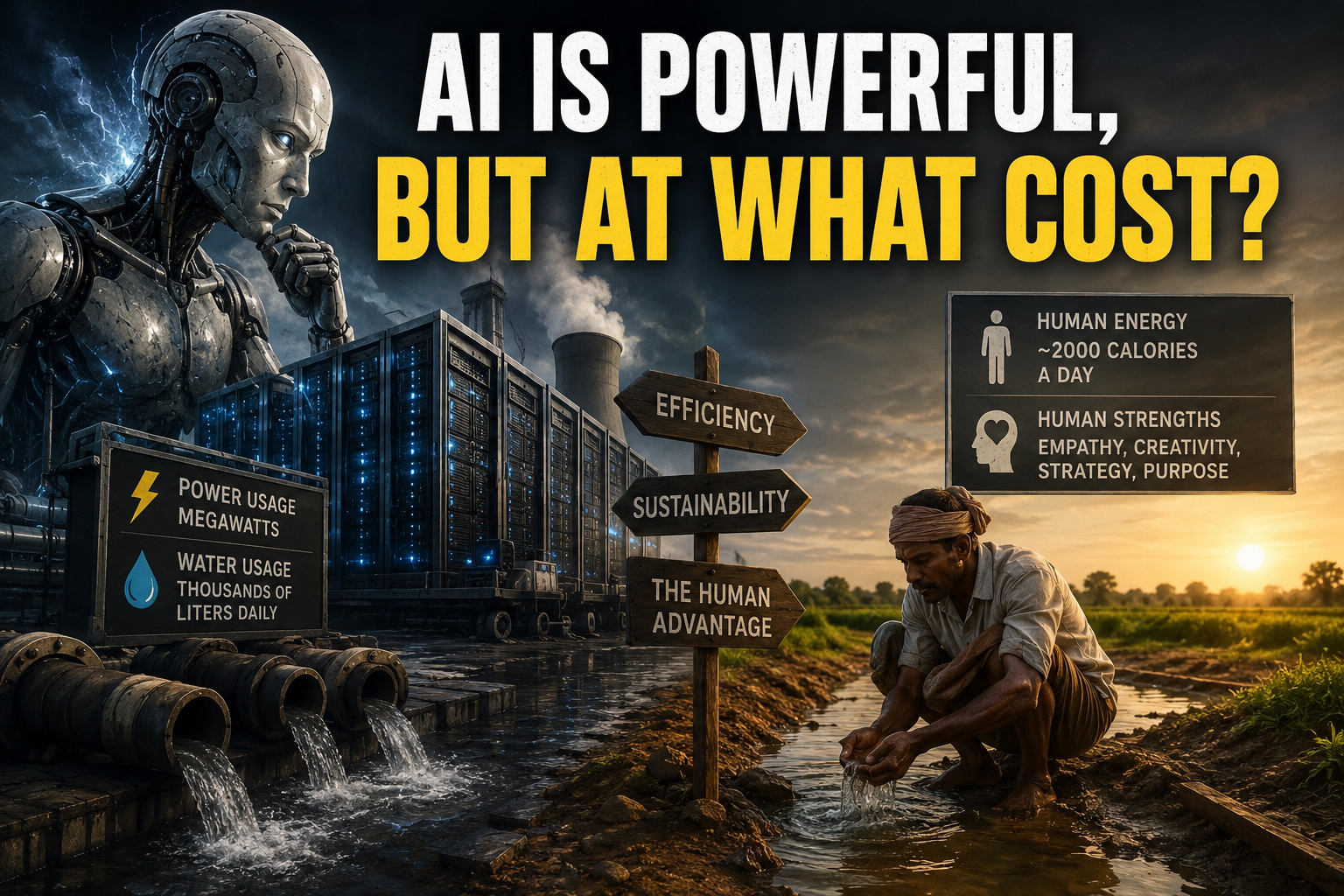
We all assumed that machines would always be more cost-effective than human beings. However, that assumption is beginning to break down. Training a large AI model to perform nuanced tasks can be far more expensive than relying on human expertise. We know that AI works on statistical models, but what is often overlooked is that it runs on electricity and requires extensive cooling. Many data centers rely on freshwater for cooling, and freshwater is a limited resource on Earth. A human being needs roughly 2,000 calories a day to carry out daily cognitive and physical activities, whereas training and operating advanced AI systems can require megawatts of electrical power.
This is not the first time we have imagined a battle between humans and machines. Yet, in the end, human beings remain the ultimate plug-and-play technology. When AI performs well, we often overlook the cost of failure. When a human makes a mistake, it can usually be traced, understood, and corrected. However, if an AI system makes an error early in a decision-making process, the consequences can spread rapidly before anyone notices. The true cost of managing AI errors, legal liability, and oversight is still not fully reflected in most economic analyses. We have not yet fully accounted for the cost of AI hallucinations or the insurance and governance mechanisms that may eventually be required to manage them.
So, how long will humans remain the cheaper option? We are innovative enough to find solutions. Researchers are already developing smaller and more efficient language models that consume less energy and water. The history of solar panels offers a useful analogy. They were once expensive and accessible only to a small group of people, but technological improvements and economies of scale have made them affordable for millions. AI is likely to follow a similar path.
Another important question is: Where will humans become obsolete first? This transition will not happen everywhere at the same time. Countries facing labour shortages due to ageing populations are likely to adopt AI much faster. In contrast, countries with abundant and inexpensive labour may experience a slower pace of automation because the economic incentive to replace workers is lower.
This is why it is time to invest in the human premium—the capabilities that AI cannot easily or cheaply replicate, such as empathy, creativity, ethical judgment, leadership, and high-level strategic thinking. The goal is not to compete with machines. The goal is to use AI to eliminate repetitive and tedious work while allowing humans to focus on the activities that give life meaning and create lasting value.
The future does not have to be dystopian; it has to be well managed. After all, if we are intelligent enough to build machines that can outperform us in many tasks, then we are surely intelligent enough to build an economy and a society in which humans continue to thrive alongside them.