
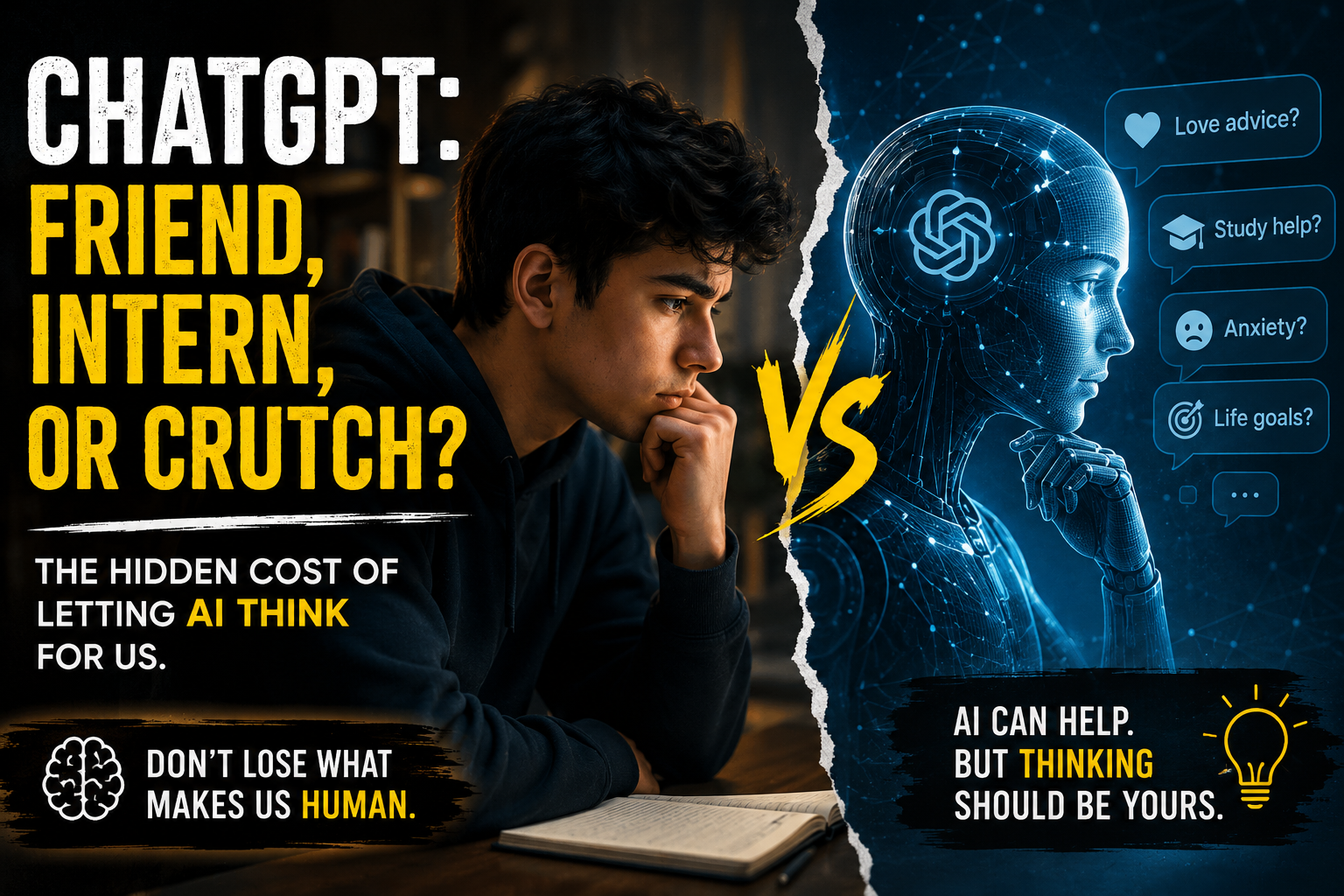
Nowadays, we talk about everything through ChatGPT—love, friendship, dreams, fears, anxiety, and much more. Even when a professor asks a question in class, many of us look for answers through ChatGPT instead of using our own brains. When we have to reply to our crush, we often seek help from ChatGPT so that our response does not sound awkward or overreactive.
At first, we think we are using ChatGPT casually. However, on closer observation, it becomes clear that ChatGPT has started to act as an emotional companion for many young adults. AI is no longer just a productivity shortcut; it has become an active participant in our daily lives. Older generations mostly use it to draft emails or assist with work-related tasks, but younger people often use it for much more personal reasons.
In many ways, AI is like an intern—don’t trust it completely, but it can help get things done if you keep an eye on it. One thing we must remember is that we cannot allow our critical thinking skills to atrophy. When people start personifying their tools and referring to them as friends, companions, or even interns, it signals something beyond mere utility.
We tend to trust AI because conversations with it do not feel like interactions with a machine. It offers rational thoughts, breaks down complex problems, and helps us reach conclusions that feel satisfying and well-reasoned. Since AI can remember previous conversations, we often forget that, at the end of the day, it is still a machine.
But there is a hidden cost. What happens if every question is answered instantly? What happens if every problem is solved with minimal effort? Convenience is valuable, but we must be careful not to surrender the very skills that make us human. We need to decide what we allow AI to influence and what should remain off-limits.
Technology should support our thinking, not replace it. As AI becomes more deeply integrated into our lives, we must remain grounded in the habits of reflection, curiosity, creativity, and independent thought—the qualities that truly make us human.