
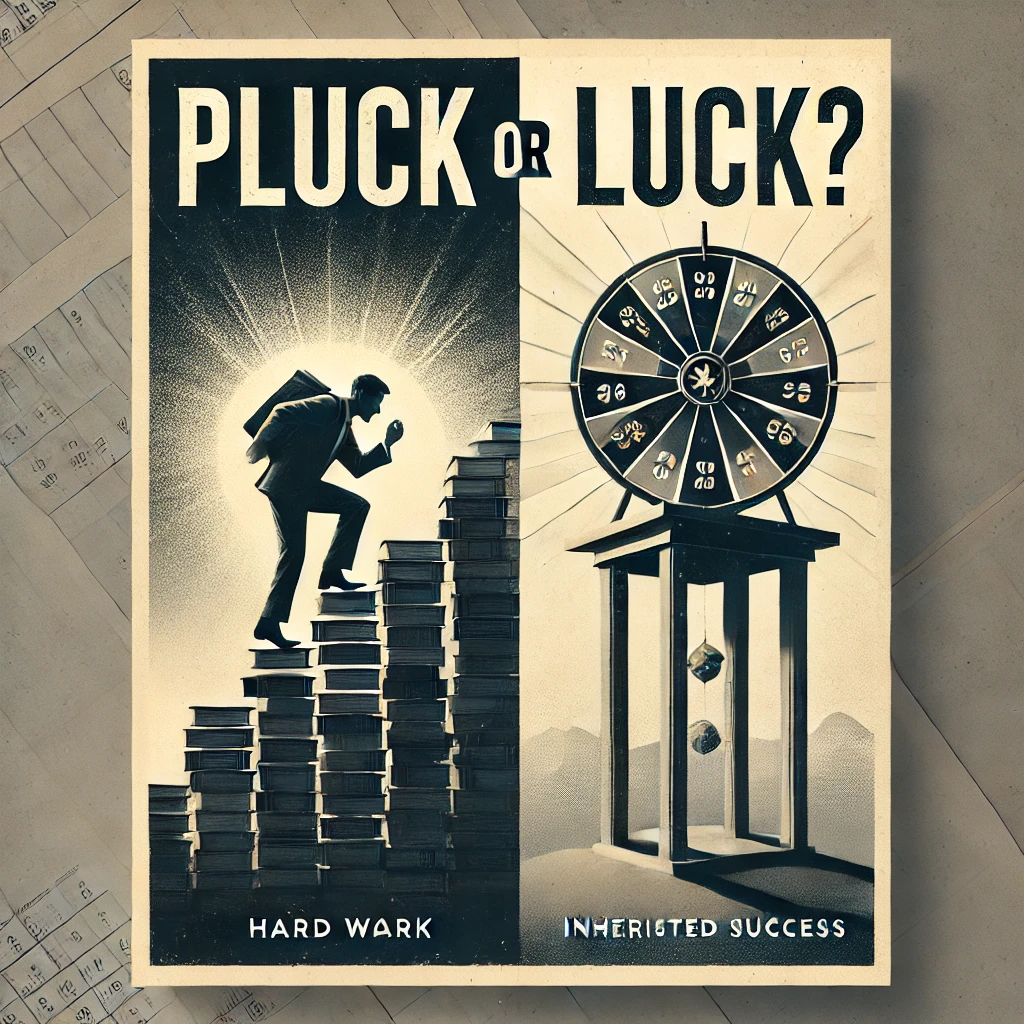
Meritocracy emphasizes the power of the individual to overcome obstacles, but reality can be different.
Life is often filled with stirring stories, especially those that comfort us with tales of grit and determination overcoming adversity. The idea is that hard work can lead to success and entry into the “Promised Land.” But there are other stories, too, where luck plays a bigger role than effort—luck from the circumstances one is born into. Let me share a story from both perspectives:
As a child, I was shy and not great at sports, but I was a good student and became the captain of the Red Club Society in high school. I was later elected president of the school. Since I was a good student, I got direct admission to Harvard to study sociology. After graduating, I couldn’t find a job and returned to my hometown, where I ended up working in banking, dealing with the public. Displeased with the job, I quit and became a reporter in a suburban area, but I hated it too.
One day, I saw an advertisement for a sociology instructor at a college. I applied and got selected, but soon discovered I needed a postgraduate degree for full-time work. I completed my PG degree and later a PhD. Then, I started publishing my research. I got interview calls from Yale University, the University of Cincinnati, and Widener University. However, the only offer I received was from Widener University, a small institution in my hometown. It felt like I had hit the bottom of the meritocratic ladder.
Then, a lifeline came. I applied to the University of Michigan and was selected. After 15 years of college and 4 years of applying for jobs, my career finally took off. The university was excellent, and I served there for 5 years before getting the opportunity to apply to Stanford, one of the world’s top universities. I was selected. I worked there for 18 years until my retirement.
I can say that life at the top is much better—teaching loads, pay, facilities, intellectual culture, education, travel, and even the weather. No matter how hard things were at first, talent eventually won.
Now, another story:
I was born into a family business. My parents grew up at the doorsteps of universities, and their parents were professors. At that time, students were predominantly black, and faculty were white clergy. My grandparents were clergy, and they had strong social values. We were poor in money but rich in connections with high-class people. I discovered that in the previous 14 generations of my family, most of them were professors.
I was the model Harvard student—a white, upper-class individual from an elite family. Both my parents attended elite colleges and heavily invested in my social and extracurricular activities. They sacrificed a lot by living in a small house but believed in investing in skills. This background gave me a significant edge in social and cultural activities. I went to an elite high school, where I learned how to write and communicate. Later, I graduated from Harvard University, although I rarely attended classes and was more interested in student politics, leading to low grades.
The question is, how did I land my first job? The vice president of that university was a friend of my father. And Stanford? That was thanks to my elite Harvard degree. Even with low grades, having an elite degree in hand gives you the benefit of the doubt.
So, was this pluck or luck?